
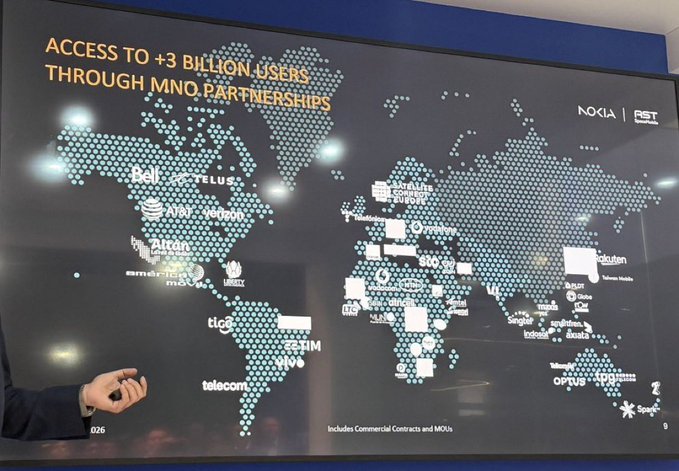


AST SpaceMobile is positioning itself as a major player in “direct-to-device” satellite connectivity—the next evolution in mobile coverage. Their goal? To reduce or eliminate dead zones by allowing standard LTE and 5G smartphones to connect directly to satellites when terrestrial towers are out of reach.
This week, a notable Canadian angle emerged: Bell and TELUS have both appeared on AST SpaceMobile’s global MNO partner map.
This suggests that TELUS may have signed an agreement (reported as a Memorandum of Understanding, or MOU) to join Bell in AST’s ecosystem. While TELUS has not publicly confirmed details yet, if this partnership moves from paperwork to active service, it could fundamentally reshape how Canadians experience coverage in remote areas.
Quick Facts
- Global Reach: AST reports having “over 50” mobile network operator partners globally.
- Seamless Tech: Switching between cell towers and satellite coverage is designed to be automatic and seamless.
- No New Hardware: AST’s BlueBird satellites aim to provide 4G and 5G broadband to everyday devices—no bulky satellite phones required.
- The Bell Connection: Bell has already been tied to AST’s efforts, with successful test calls cited in AST’s partner testing history.
- The TELUS Scoop: TELUS appearing on the partner map is a strong signal of an MOU, though no formal announcement has been issued as of this writing.
What is AST SpaceMobile and Why Does It Matter?
AST SpaceMobile’s pitch is simple but ambitious: end dead zones by using satellites that function as “cell towers in space,” connecting directly to the smartphone already in your pocket.
If this becomes a fully realized consumer service in Canada, the impact would be massive for:
- Travelers: People driving through remote highways and rural regions.
- Outdoor Enthusiasts: Hikers, hunters, and campers venturing off the grid.
- Remote Workers: Resource sector and construction crews operating far from cell towers.
- Northern Communities: Areas where building physical towers is difficult or economically unfeasible.
In short, this isn’t about getting “faster speeds” in downtown Toronto or Montreal; it’s about basic connectivity and safety where coverage is currently weak or non-existent.
Signal, Not Confirmation: Interpreting the Map
Seeing Bell and TELUS on a partner map is significant, but it is not the same as a launch announcement. There is a long road between a logo on a map and a working signal on your phone. The typical path includes:
- Strategic agreement (MOU)
- Network integration and field testing
- Device compatibility certification
- Regulatory approval
- Commercial launch (Pricing & Plans)
For now, the practical takeaway is that Bell appears firmly aligned with AST, and TELUS seems to be joining the fold. This would place two of Canada’s “Big Three” carriers in the AST camp.
The Canadian Split: AST vs. Starlink
Canada’s direct-to-device satellite landscape is shaping up to be a two-track race, splitting the major carriers into opposing camps:
- Team AST SpaceMobile: Bell and (potentially) TELUS.
- Team Starlink: Rogers, which has partnered with SpaceX’s direct-to-cell initiatives.
Why does this matter to you? The partner your carrier chooses will influence crucial factors like launch timing, coverage maps, add-on pricing, and feature sets (e.g., will it support voice and data immediately, or just text messaging at first?).
As these satellite constellations grow, PlanHub will keep you updated on which carriers offer the best coverage for the great Canadian outdoors.