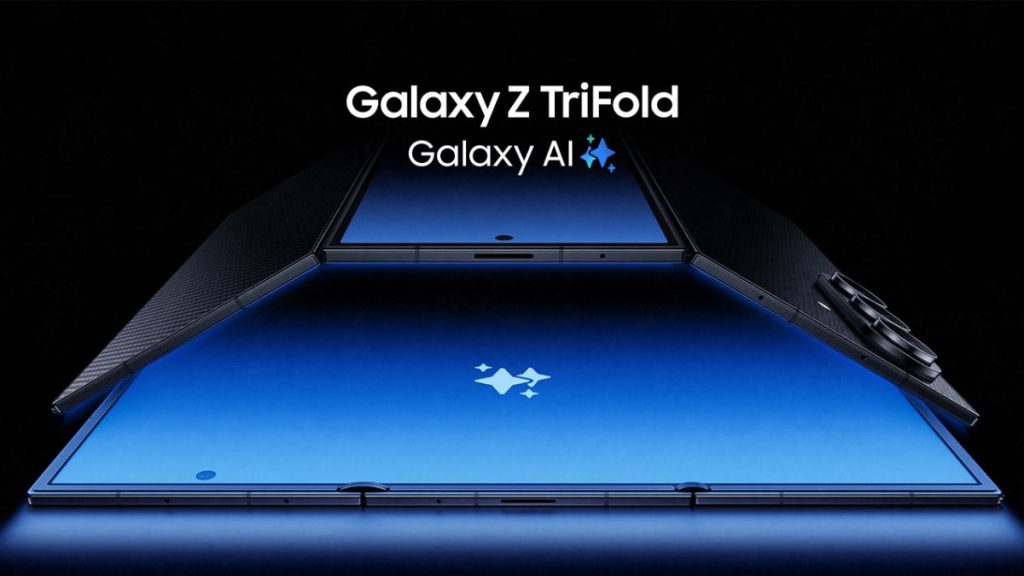


Samsung had high ambitions for its first tri-fold smartphone. With the Galaxy Z TriFold, the company confidently claimed a lifespan of 200,000 folds, a figure meant to reassure buyers about the durability of this bold new form factor. To see how that promise holds up outside the lab, a South Korean shopping mall decided to put the device through an extreme real-world stress test, broadcast live on YouTube.
When the folding never stops
For days on end, the Galaxy Z TriFold was folded and unfolded without pause. Every movement was logged, every cycle counted. At first, everything appeared normal. Then, well before reaching Samsung’s stated goal, the first signs of fatigue began to surface.
After roughly 61,000 folds, a subtle but unmistakable creaking noise emerged from one of the hinges. It was not a failure, but it was noticeable. By the time the counter passed 121,000 cycles, the second hinge started to behave the same way. The phone still worked, but the smoothness was gone.
The real breaking point came near 144,000 folds. At that stage, the hinge mechanism had weakened enough that the device could no longer remain fully open on its own. Structurally, the phone was still intact. Mechanically, it was clearly struggling.
The screen holds, the hinges give way
What makes this test particularly interesting is what did not fail. Throughout the entire ordeal, the foldable display kept working flawlessly. No dead pixels appeared, no dark spots formed, and no visible damage was reported. While the hinges absorbed the stress, the screen quietly held its ground.
On paper, falling short of the promised 200,000 folds may look disappointing. In practice, the context matters. This was an extreme scenario, far removed from everyday use. No consumer opens and closes a phone thousands of times a day, and the testing setup, including sensors attached to the screen, may have added extra pressure on the hinges.
The comparison with Samsung’s more established foldables also helps explain the outcome. The Galaxy Z Fold 7, a two-panel device refined over several generations, is rated for up to 500,000 folds. The TriFold, with its far more complex triple-hinge design, clearly sits in first-generation territory, where innovation often comes before endurance.
In the end, the Galaxy Z TriFold survived an almost absurd folding pace for close to 144,000 cycles before its mechanics began to give in. The screen, however, remained untouched. More than a verdict, this test feels like an early reality check for a new category of foldable devices that is still finding its limits.