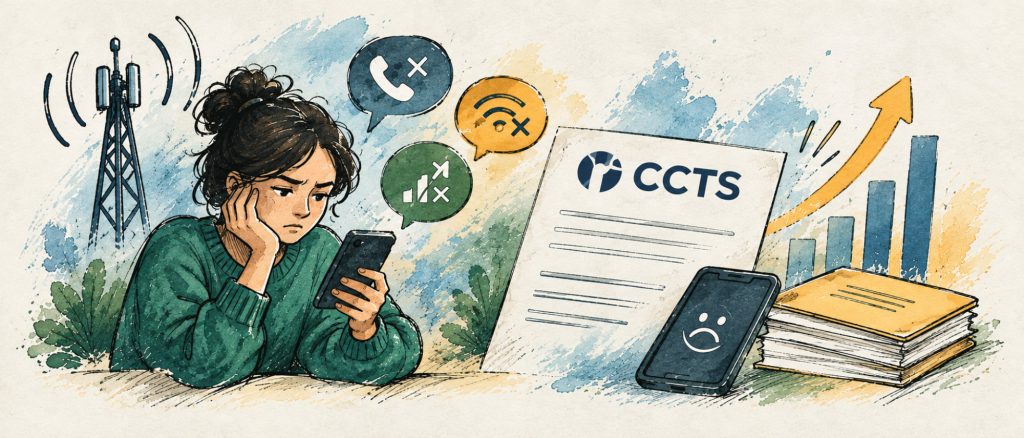


Canadians have never complained so much about their telecom providers. According to preliminary figures released on October 15, 2026, the Commission for Complaints for Telecom-television Services (CCTS) received 53,195 complaints in 2025-26, 79% more than the year before.
Inflated bills, internet outages that drag on, fees nobody told you about: if you’re in a dispute with your cellphone, internet or TV provider, here’s what this surge means for you, and how to get a solution as quickly as possible.
The key numbers for 2025-26
Despite record volume, nearly 9 out of 10 concluded complaints were resolved.
Indicator | 2025-26 | Change over one year |
|---|---|---|
Complaints received | 53,195 | +79% |
Complaints accepted | 41,235 | +74% |
Overall resolution rate (concluded complaints) | 87.2% | not disclosed |
For scale, these increases work out to roughly 29,700 complaints received and 23,700 accepted the previous year (calculated from the announced percentages).
An “accepted” complaint is one that falls within the CCTS mandate. The others are referred to the appropriate organization when one exists.
The breakdown by provider and by type of issue will be released in the full annual report, expected on January 13, 2027.
What exactly is the CCTS?
The CCTS is the independent organization that resolves disputes, free of charge, between consumers (and small businesses) and their phone, internet and TV providers. More than 400 providers participate.
It’s often confused with the CRTC, but their roles are different:
- The CCTS handles your individual complaint. It can require the provider to apologize, fix the problem (billing error, reconnection, stopping collections) or reimburse proven financial losses, up to $5,000.
- The CRTC, as the regulator, can penalize providers or require them to change their practices. The CCTS does not do this.
The CCTS also oversees compliance with CRTC codes, such as the Wireless Code and the Internet Code.
Longer wait times: what it means for you
If your complaint is simple, it should still be resolved quickly. The CCTS says it continues to resolve most files in the early stages of its process.
However, files that require conciliation or investigation are taking longer than usual, and the organization warns these delays may last as long as demand stays this high.
In practice, a well-prepared file, ideally settled directly with your provider, will save you a lot of time.
Before you complain: 5 habits to adopt with your provider
You must first give your provider a reasonable opportunity to fix the problem. It’s mandatory before going to the CCTS, and it’s often the fastest route.
- Be clear. Describe the problem and say exactly what you expect: a credit, a billing correction, a repair, a cancellation.
- Keep everything. Bills, contract, chat transcripts, emails and reference numbers.
- Log every contact. The date, the name or employee number of the customer service agent, and what you were promised.
- Cooperate with reasonable solutions. Troubleshooting, a technician appointment, waiting for a credit on your next bill: let the process run its course.
- Escalate if needed. If nothing is resolved and the issue falls within the CCTS mandate, you can then file a complaint.
Tip: keep a simple file or a note on your phone with a timeline of your exchanges. If you do need to file a complaint, half the work will already be done.
How a CCTS complaint works
The process has four steps, and the vast majority of complaints are resolved at the second one.
- Submission and assessment. The online form takes about 15 minutes. The CCTS then checks that the complaint falls within its mandate.
- Referral to the provider. The CCTS sends your complaint to your provider, which must work with you and report back within 20 days. Respond promptly at this stage.
- Conciliation and investigation. If nothing is resolved, the CCTS acts as a mediator. Failing an agreement, it reviews both parties’ documents and issues investigation findings. This is the step currently slowed down.
- Outcome. You can accept or reject the findings. If you accept, the provider must carry out the remedies. If you reject them, you keep your other legal options.
Good to know: if your complaint involves unpaid charges, the provider must stop trying to collect those amounts until the file is closed. You still have to pay any charges that aren’t in dispute.
What if the real fix is switching providers?
A complaint solves a one-time problem, but it doesn’t change your relationship with your provider. If the frustrations keep piling up, it may be worth shopping for a new plan.
Before you leave, check your contract: end of your commitment, remaining balance on your phone and any cancellation fees.
With PlanHub, you can compare the cellphone and internet plans available at your address in just a few clicks, from big providers and smaller ones alike.
And whether your experience was good or bad, leave a review of your provider on PlanHub: your feedback will help other consumers make the right choice before they sign.
Frequently asked questions
Does filing a complaint with the CCTS cost anything?
No, the service is completely free for consumers.
How long does it take to resolve a complaint?
Most are resolved at the referral stage, where the provider has 20 days to report back. Files that move on to conciliation or investigation are currently taking longer than usual.
Can I file a complaint directly, without contacting my provider?
No. You must first give them a reasonable opportunity to fix the problem.
Which services are covered?
Cellphone, home phone, internet and TV, with participating providers.
When will we know which providers got the most complaints?
The full 2025-26 annual report, with the breakdown by provider, will be published on January 13, 2027.