


For years, changing an Internet or mobile plan in Canada often felt harder than it needed to be. Customers had to call, wait, negotiate, dodge extra fees, track the end of promotions, and hope the new offer was actually better than the old one.
Now, the CRTC is clearly trying to change that.
Over the past few weeks, the regulator has announced several decisions that affect how Canadians manage their telecom services. The changes touch switching fees, expiring discounts, roaming alerts, self-service cancellation, and even the wholesale fibre rates that help competitors bring new Internet offers to market.
Taken separately, these decisions may sound technical. Taken together, they point toward a bigger shift: Canada’s telecom market is being redesigned around easier comparison, easier switching, and more consumer control.
Switching should not feel like a penalty
The first major change is the elimination of certain fees that made it harder to activate, modify, or cancel Internet and cellphone plans. Starting June 12, 2026, providers will no longer be allowed to charge fees that discourage customers from changing plans or cancelling services, with reasonable exceptions such as physical installation fees or optional products chosen by the customer.
This matters because fees create hesitation. Even when a better plan exists, a $60 or $80 charge can make people delay the switch. Customers may stay with an outdated plan not because it is the best option, but because leaving feels expensive.
The CRTC’s message is simple: competition cannot work properly if leaving a bad deal comes with a toll booth.
Promotions will no longer be able to expire quietly
The CRTC is also changing how customers are notified before a contract, discount, or promotion ends. Providers will need to send notices in advance, including 90-day notifications in certain situations, with useful information such as links to available plans and instructions on how to access them.
That changes the role of the promotional discount. Instead of becoming a quiet trap that ends with a higher bill, the end of a promotion becomes a decision point. Customers can compare, renegotiate, switch plans, or leave before the increase hits.
The same logic applies to roaming. Providers will have to notify customers when international roaming data charges reach $50, halfway to the existing $100 roaming cap. The goal is to reduce bill shock and help users adjust before the cost gets out of hand.

The real shift is the exit button
The most important change may be the least flashy one. By April 26, 2027, providers will need to let customers modify or cancel their Internet or cellphone plans through a self-service mechanism, such as an app, website, or email. Customers must also receive written confirmation after using that mechanism.
This is where comparison tools become more powerful.
It is one thing to find a better plan. It is another thing to actually leave your current provider without calling, waiting on hold, dealing with a retention script, or wondering whether the change was properly processed.
Self-service cancellation reduces the friction between “I found a better deal” and “I switched.” That is the missing piece in many telecom markets.
Prices are falling, but Canadians still need to check their usage
The broader market is already moving. According to the CRTC’s 2026 Telecommunications Market Report, since early 2021, the Internet price index has dropped by 6% and the mobile service index has fallen by nearly 40%, while the overall Consumer Price Index rose by 19%.
But lower prices do not automatically mean every customer is on the right plan. Many Canadians are also choosing faster Internet speeds and larger mobile data buckets. That means some households may still be overpaying, not because cheaper plans do not exist, but because their plan no longer matches their real usage.
This is why comparing plans should not be something people do only when they are angry at their bill. It should become a regular habit.
Why real usage matters more than guessing
The best mobile plan is not always the plan with the most data. It is the plan that matches your actual needs, your location, your budget, your device, and your habits.
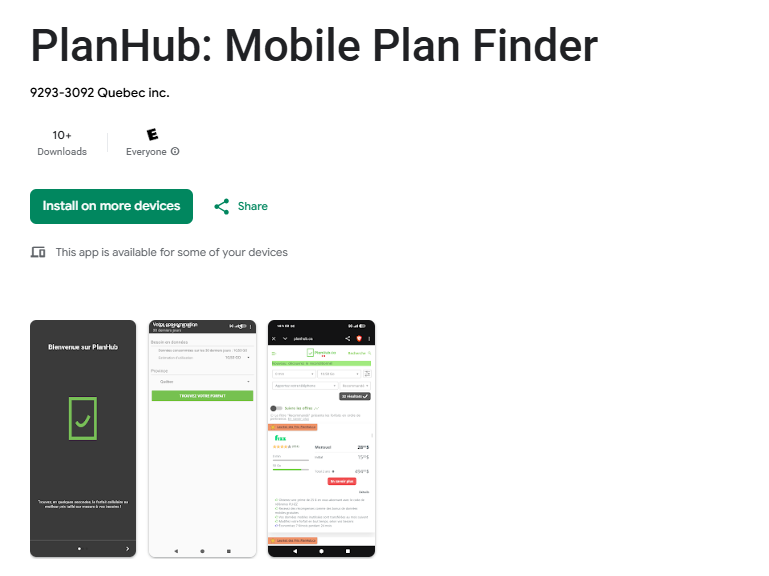
That is why the new PlanHub app arrives at the right moment. With the user’s permission, the app can analyze the last 30 days of mobile data consumption, compare thousands of plans across Canada, and help users find offers based on real usage instead of guesswork.
In a market where switching fees are being removed, promotions must be flagged more clearly, cancellation will become easier, and fibre competition is becoming more structured, Canadians have more reason than ever to check their options.
The CRTC is changing the rules of the road. But consumers still have to decide when to move.
And in this new telecom landscape, comparing plans is no longer just a money-saving trick. It is becoming the new normal.